¶ History of Neutrality (1515--2024)
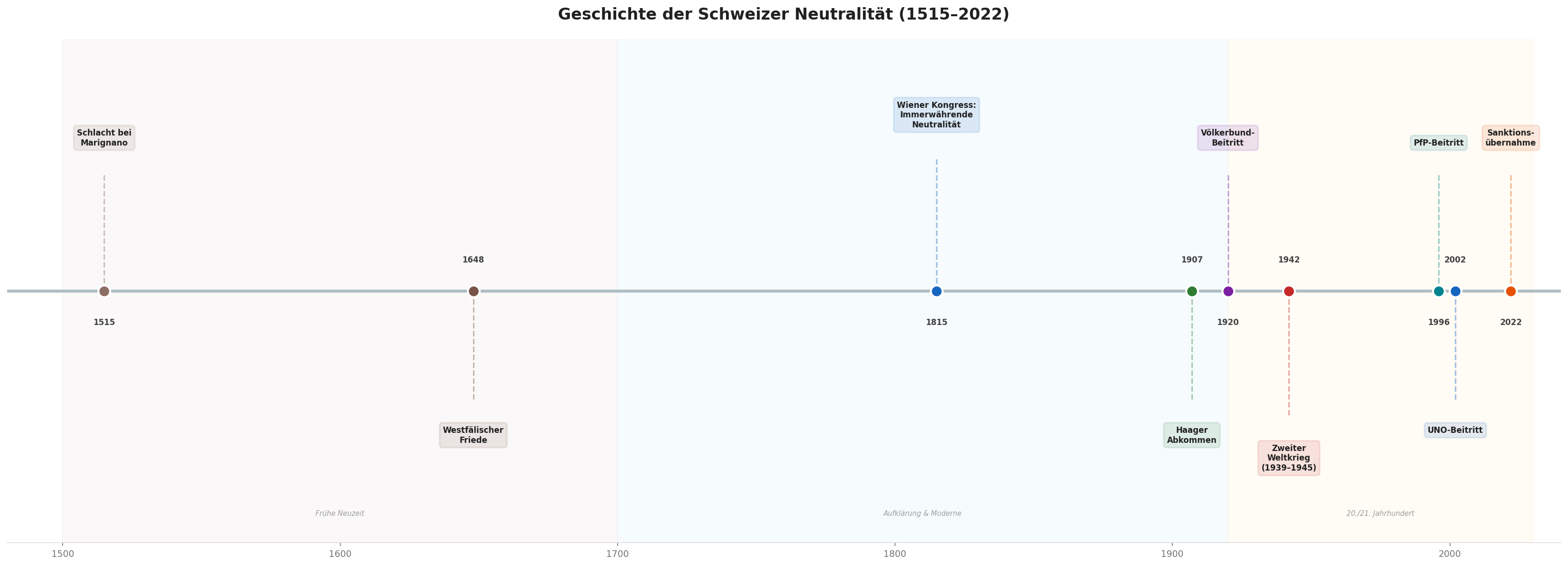
Summary: Swiss neutrality has evolved over 500 years -- from pragmatic restraint following the defeat at Marignano (1515), through international legal recognition at the Congress of Vienna (1815) and codification in the Hague Conventions (1907), to the paradigm shift triggered by the adoption of sanctions in 2022. This page traces the most important milestones.
¶ 1. Early Phase: Marignano to the Congress of Vienna (1515--1815)
¶ The Battle of Marignano (1515)
The defeat of the Confederates against France at Marignano on 13/14 September 1515 is popularly regarded as the birth of Swiss neutrality. More recent research, however, qualifies this interpretation: Marignano did lead to a more cautious foreign policy, but Swiss cantons continued to participate in military campaigns thereafter (e.g. as mercenaries) [1][2].
¶ The Peace of Westphalia (1648)
The Peace of Westphalia formally recognised the independence of the Swiss Confederacy from the Holy Roman Empire. Neutrality was implicitly contained therein, without however being explicitly codified [1].
¶ The Congress of Vienna (1815)
On 20 March 1815, the European great powers recognised "permanent neutrality" of Switzerland at the Congress of Vienna and guaranteed the integrity of the then 22 cantons. This was the first international legal anchoring of Swiss neutrality and remains its legal foundation to this day [3][4].
¶ 2. Codification and the League of Nations (1907--1920)
¶ The Hague Peace Conferences (1907)
The Fifth and Thirteenth Hague Conventions codified for the first time the rights and obligations of neutral states in land and naval warfare. This gave neutrality a binding form under international law (see Hague Conventions and International Law) [5].
¶ League of Nations Accession (1920)
On 16 May 1920, the Swiss people voted to join the League of Nations with 56.3 per cent in favour. Switzerland was granted the status of "differential neutrality": participation in economic sanctions was possible, but military involvement remained excluded [6].
¶ 3. Second World War (1939--1945)
Switzerland's role in the Second World War is historically contested and complex [7]:
- Officially, Switzerland maintained its neutrality and upheld national defence (General Guisan, Reduit strategy).
- Economically, Switzerland made significant concessions to Nazi Germany: gold transactions through the Swiss National Bank, transit traffic via the Gotthard railway, and trade credits.
- Refugee policy was restrictive: Jewish refugees turned away at the border remain a dark chapter.
- The Bergier Report (2002) critically documented these connections.
Important: Historians emphasise that it was not neutrality alone that protected Switzerland from invasion, but also strategic calculations of the Axis powers (Switzerland's utility as a financial and transit hub) and its geographical location [7][8].
¶ 4. Cold War: Informal Western Alignment (1945--1989)
During the Cold War, Switzerland officially practised strict neutrality but was de facto informally aligned with the West:
- Economic integration into Western structures
- Intelligence cooperation (P-26, secret army)
- No UN membership (only in 2002)
- No membership in the League of Nations after its refounding as the UN
¶ 5. New Opening (1996--2021)
| Year | Event | Significance |
|---|---|---|
| 1996 | Partnership for Peace (PfP) | Switzerland joins NATO's cooperation programme [9] |
| 2002 | UN accession (54.6% Yes) | Popular vote on 3 March 2002; cantons 12:11 [10] |
| 2014 | Crimea crisis | Switzerland adopts EU sanctions against Russia for the first time (without its own) |
¶ 6. Paradigm Shift 2022
On 28 February 2022, four days after the Russian attack on Ukraine, the Federal Council decided to adopt the EU sanctions against Russia. This marked a historic paradigm shift: for the first time in modern history, Switzerland adopted comprehensive economic sanctions against a belligerent state (see Erosion Since 2022).
¶ References
[1] aboutswitzerland.eda.admin.ch (2024). Neutrality.
Federal Department of Foreign Affairs. [Open Access]
[2] Wikipedia (2024). Neutrality of Switzerland.
Wikipedia. [Open Access] Note: Encyclopaedia as overview, primary sources linked in the article
[3] swissinfo.ch (2015). The day Switzerland became neutral.
SWI swissinfo.ch. [Open Access]
[4] Swiss National Museum Blog (2019). The Congress of Vienna and Switzerland.
Swiss National Museum. [Open Access]
[5] Fedlex (1907). Fifth Hague Convention (SR 0.515.21).
Classified Compilation of Federal Legislation. [Open Access]
[6] Parlament.ch (1920). Parliamentary debates on League of Nations accession.
Swiss Federal Assembly. [Open Access]
[7] swissinfo.ch (2023). The Second World War continues to question neutrality.
SWI swissinfo.ch. [Open Access]
[8] Schweizer Monat (2023). Between mythical elevation and disdain.
Schweizer Monat. [Open Access]
[9] FDFA (2024). NATO -- Partnership for Peace (PfP).
Federal Department of Foreign Affairs. [Open Access]
[10] swissinfo.ch (2002). UN accession -- the end of the Swiss paradox.
SWI swissinfo.ch. [Open Access]
Last updated: March 2026